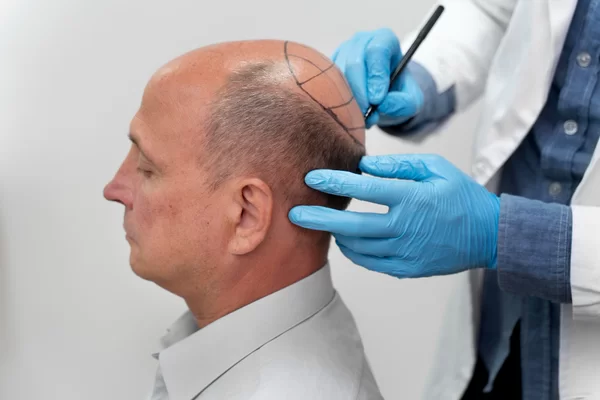
Hair transplant is a surgical procedure that involves moving healthy hair follicles from a donor area, usually the back or sides of the scalp, to areas affected by hair thinning or hair loss. It may be performed to improve hair density and restore the appearance of the hairline, crown, or other areas with reduced hair growth. The treatment plan is customised according to the pattern and extent of hair loss, donor hair availability, hair thickness, age, medical history, and previous hair-loss treatments. Since transplanted hair grows gradually, visible results develop over several months and continue to improve as the hair grows. The objective is to achieve natural-looking and long-lasting hair restoration while making the best use of the available donor hair.
• Hair transplant is most suitable when there is a sufficient supply of healthy donor hair follicles that can be moved to areas affected by hair loss. • Hair growth after a transplant takes time because the transplanted follicles go through a healing and growth cycle. Visible results develop gradually over several months. • Common treatment areas include the front hairline, temples, crown, and other areas affected by hair thinning or hair loss. • Additional treatment or hair-loss management may be needed over time because existing non-transplanted hair can continue to thin due to genetics, ageing, or other factors.
Hair transplant treatment is customised according to the pattern of hair loss, donor hair availability, hair characteristics, and the area being treated. These answers explain preparation, the procedure, recovery, results, and possible risks..
A hair transplant is a surgical procedure that moves healthy hair follicles from a donor area, usually the back or sides of the scalp, to areas affected by hair thinning or hair loss. The transplanted follicles can help restore hair density and create a more natural-looking hairline.
A hair transplant may be used to restore hair on areas such as the front hairline, temples, crown, and other areas affected by hair loss. It can also be considered for certain cases of eyebrow or facial hair restoration, depending on the individual’s needs and available donor hair.
The number of sessions depends on the extent of hair loss, the size of the treatment area, the availability of donor hair, hair thickness, and the desired level of density. Some patients may achieve their desired result in one session, while others may require additional sessions.
A hair transplant is intended to provide long-lasting hair restoration. The transplanted follicles are generally taken from areas that are more resistant to hair loss. However, existing non-transplanted hair can continue to thin over time, so ongoing hair-loss management may be recommended.
A hair transplant is performed using local anaesthesia to minimise discomfort during the procedure. Some mild soreness, swelling, or sensitivity may occur after treatment, but these effects are generally temporary and can be managed according to the aftercare instructions.
Whether the hair needs to be shaved depends on the technique used, the treatment area, and the surgeon’s approach. Some procedures may require partial or complete shaving, while in selected cases the hair may be kept longer.
Not everyone is a suitable candidate for a hair transplant. Suitability depends on the cause and pattern of hair loss, the availability and quality of donor hair, the condition of the scalp, medical history, and the expected long-term progression of hair loss.
Â
After the procedure, the scalp may have some redness, swelling, or mild discomfort. The transplanted area requires gentle care during the early healing period. The transplanted hairs may initially shed, which can be a normal part of the process, before new hair growth develops gradually.
Hair growth after a transplant takes time. Initial growth may become noticeable after several months, while the hair continues to become thicker and more natural-looking over time. The final result can take several months to develop.
Possible risks may include temporary swelling, redness, bleeding, infection, scalp sensitivity, scarring, or uneven hair growth. The risks vary depending on the individual, the procedure, and the healing process. A consultation is important to understand the risks specific to each patient.
WhatsApp us
Dr. Sunish Goyal, MBBS, MS, MCh (Plastic Surgery)
Disclaimer: The content published on lavanyacosmeticsurgery.com is intended for spreading information and generating awareness about cosmetic and plastic surgery procedures only. The treatments and results shown on this website may vary, as they depend on each individual patient and their condition. Please consult Dr. Sunish Goyal for advice specific to you.
One of our experts will contact you soon to discuss your concerns and the best treatment options.